
Does a Business Actually Need to Be Loved, or Just Trusted?
I keep coming back to this one. More than I'd expected to, actually.
"Let's make customers fall in love with the brand."
I've heard some version of that sentence in boardrooms, brainstorms and campaign kick-offs for years. I've probably said it myself a few times. It sounds like the right ambition. Who wouldn't want to build a brand people love?
I'm just not sure it's the one I'd choose anymore.
When I think about the businesses I've stayed loyal to over the years, love doesn't feature very much. I trusted them to show up. To fix things when they broke. To do what they said they would do. To not make me think twice before buying from them again. Most weren't particularly exciting. Some weren't even memorable in the traditional marketing sense.
I just never had a reason to leave.
Funny thing is, that's a much quieter kind of success. Nobody writes case studies about brands that simply kept their promises for ten years. There's no campaign celebrating "remarkably dependable." Yet, as customers, I think we reward that behaviour far more often than we admit.
Maybe that's why I get a little uneasy when a brief starts with emotional words before operational ones. We spend a surprising amount of time talking about admiration, affinity and love, while giving much less attention to consistency, reliability and trust. One makes for a much better creative presentation.
The other tends to build businesses that survive.
Of course, I could be creating a distinction that doesn't really exist.
Maybe love is simply what trust becomes after enough promises have been kept. Or maybe they're two completely different things, and we've spent years chasing the one that's easier to put on a mood board.
I honestly don't know.
I just know that if someone gave me the choice, I'd rather build a business people rely on than one they say they adore.
The rest, I suspect, has a habit of following.
OPEN LOOPS
I’m still thinking about this one.
NEXT IN OPEN LOOPS
ANOTHER OPEN LOOP
I've got another question I haven't answered yet.
COMING SOON
Market Signal Architecture
For years, I kept getting invited into businesses after growth had already slowed, after positioning had weakened, after the evidence was impossible to miss. By the time marketing entered the conversation, the market had usually finished having its own. Marketing has this funny habit of getting invited once everyone else has already had the interesting argument.
After seeing that happen often enough, I realised I was becoming less interested in fixing what had already broken and more interested in the part that came before it. What does a business look like just before everyone agrees there's a problem? More importantly, does the market start whispering long before the numbers start shouting?
That question has followed me around for years.
Not because I think markets are predictable. If they were, we'd all be retired on an island somewhere instead of sitting through strategy reviews. But I have noticed something that I can't seem to ignore. Sales conversations start drifting. Customers describe the business differently from the way the business describes itself. Competitors begin responding to a version of the company leadership hasn't quite recognised yet. None of those things look particularly dramatic in isolation. Looking back, though, they're often the first clues that something has already started changing.
Maybe strategy spends too much time waiting for proof and not enough time paying attention to signals.
That thought eventually became Market Signal Architecture. It's also the reason I founded ARRA.
I should probably clarify something here. I'm not trying to invent the next marketing framework with a memorable acronym and a deck full of triangles. I think we've all seen enough of those. If this ever turns into something useful, I hope it's much simpler than that. I'd love it to become a way of helping leadership teams notice meaningful change a little earlier, while they still have options rather than obligations.
That probably sounds more confident than I actually feel.
The truth is, I'm still figuring it out.
Some weeks I feel like the pieces are starting to fit together. Other weeks I wonder whether I'm just very good at spotting patterns after they've already happened. I've lost count of the number of books I've bought because one chapter mentioned something about decision-making or behavioural psychology that felt vaguely connected. My notebook is full of half-finished diagrams and questions that made perfect sense when I wrote them down and much less sense the next morning.
Which, I suspect, is what research actually looks like.
Right now, this feels less like building a framework and more like collecting evidence. Maybe that's how most useful ideas begin. You keep noticing the same thing from different angles until it becomes difficult to dismiss as coincidence.
I don't have a clean answer yet.
Some days I think I'm getting close to something genuinely useful. Other days I think I'm still just asking a good question and calling it research.
Both are probably true.
OPEN LOOPS
This one isn’t finished yet.
NEXT IN OPEN LOOPS
Does a Business Actually Need to Be Loved, or Just Trusted?
Some questions are more useful before you answer them.
The Rebrand Everyone Congratulated Me On That I Still Think Was a Mistake
I won't name it. I probably never will. But there's a rebrand sitting in my portfolio that people still bring up as a highlight. Clean launch, good press, a leadership team that was thrilled. It's the kind of project you're supposed to look back on with not so complicated pride.
I still think about what I'd tell them differently if I could go back.
Not because the work was bad. If anything, it was some of the best execution I've ever been a part of. The strategy made sense, the rollout was smooth and the response was exactly what we'd hoped for. If someone had asked me at the time whether it was a success, I'd have said yes without thinking twice.
I’m not so certain now.
Looking back, I don't think we solved the problem that actually mattered. We solved the problem the brief described. Those aren't always the same thing.
By the time I really understood the business, I had a growing suspicion that the brief itself had quietly expired. The company had changed. The market had changed. Even the conversations customers were having had started drifting somewhere else. But the project already had momentum. There were timelines, expectations and a room full of people ready to make decisions. So we did exactly what we'd been asked to do.
And we did it well. So well.
That's the uncomfortable part.
Sometimes great execution gives everyone permission to stop asking whether they were solving the right problem in the first place. When something is delivered beautifully, it's surprisingly easy to mistake that for having solved the thing that actually needed solving. I think we all did. Me included.
I've become much slower since then. Not slower at making decisions (my teams would probably disagree with that). Slower at accepting the first version of the problem that lands on the table. They're usually presented with a lot of confidence. Confidence, I've learnt, isn't always the same thing as accuracy.
These days, I spend more time listening than people probably expect. The first few conversations are rarely about marketing. They're about how leadership talks when they stop presenting. What Sales keeps hearing that nobody has written down. Which customer stories get repeated without anyone really noticing. Funny thing is, if you stay in the room long enough, the problem statement almost always starts changing on its own.
I've never spoken publicly about that rebrand before. Maybe because I'm still working out what I actually learned from it, beyond "listen longer before you start."
I suspect the lesson is something closer to this: a beautifully executed answer can still be the wrong answer.
I'm not entirely sure I've finished thinking about that yet.
OFF THE RECORD
Sometimes being right isn't the same as getting it right.
NEXT IN OFF THE RECORD
MORE I HAVEN’T SAID
I'm not quite done embarrassing myself in public.
COMING SOON
Nobody Claps for the Meeting Where You Killed the Bad Idea
The best thing I did all quarter didn't make it into a single update, deck or all-hands.
It was a meeting where I said no.
A team I genuinely respected had spent weeks on an idea they were excited about. It was well researched, well argued and thoughtfully put together. Which, if I'm being honest, made saying no even harder.
The idea wasn't bad.
It was just wrong for where the business actually was.
Wrong in timing. Wrong in cost. Wrong in what it would quietly signal to a market that was still trying to work out what we even did.
Saying so felt terrible.
There's no leadership course that teaches you how to tell smart people who've done good work that you're not going ahead with it. You explain the reasoning. You thank them for the thinking. You try very hard to separate the idea from the people behind it.
They still hear "no."
Six months later, I was relieved we'd made that call.
Not because something spectacular happened afterwards. Nothing did.
We just didn't spend six months defending a decision that would have taken us somewhere we didn't need to go. Sometimes that's the win. It's just not the kind anyone puts on a slide.
Nobody throws a launch party for the thing that didn't happen.
There's no case study called The Campaign We Didn't Run. Nobody wins an award for the strategy that quietly stayed on the whiteboard because someone realised it belonged to next year, not this one.
The visible wins get all the attention. They're supposed to.
The invisible ones are stranger. You only notice them because the business never has to recover from them.
I've started to think that's the real job.
Not having more ideas.
Most leadership teams already have plenty of those.
The harder part is recognising which good idea has arrived a little too early.
Or a little too late.
Nobody claps for that meeting.
Honestly, that's fine.
OFF THE RECORD
Sometimes the best work is the work nobody sees.
NEXT IN OFF THE RECORD
The Rebrand Everyone Congratulated Me On That I Still Think Was a Mistake
The ones that look like wins can be the hardest to question.
What Shutter Island Gets Right About Businesses That Lie to Themselves
I won't spoil the ending for anyone who hasn't seen it.
But the part that stayed with me wasn't the twist.
It was watching someone construct an entire reality rather than face a truth that had been sitting in front of him the whole time. Even when the evidence becomes difficult to argue with, part of him still chooses the story he's more comfortable living in.
I've sat in enough boardrooms to know businesses aren't all that different.
A product that's "still finding its market" two years after the market has already answered the question. A brand story everyone quietly knows has stopped fitting, but nobody wants to be the first person to say it out loud because saying it makes it real. A strategy that's defended with increasing confidence precisely because confidence is all that's left.
None of this usually comes from arrogance.
Or dishonesty.
Most of the time, it comes from people trying to protect work they've poured years into. That's a very human thing to do. It just doesn't make for particularly good strategy.
Funny thing is, markets are rarely sentimental.
They don't care how much time, money or conviction went into an idea. They simply move on. The difficult part isn't accepting that they've changed. It's recognising they've changed before the quarterly numbers turn into an unavoidable conversation.
I think that's why this has become a bit of a professional obsession for me.
It's also why Market Signal Architecture exists.
I keep wondering whether businesses can learn to notice their own version of this before someone from the outside has to point it out. Whether leadership teams can become better at recognising the stories they're telling themselves while there's still time to write a different one.
I don't think I've figured it out yet.
I have theories.
None of them feel complete.
Which probably means I'm still asking the right questions.
WORTH STEALING
The story you keep defending might be the thing you need to question.
NEXT IN WORTH STEALING
MORE TO STEAL
I've stolen the next one.
COMING SOON
What Federer's Retirement Speech Taught Me About Knowing When to Reposition
I watched Roger Federer's retirement speech the way most people did, expecting a highlight reel of trophies and getting something closer to a eulogy for a version of himself.
What stayed with me wasn't the tears. It was the timing.
He didn't leave when he'd lost his last match. He didn't leave when his ranking finally slipped somewhere it couldn't recover. He left while he could still see, more clearly than the commentators, the sponsors or the fans in the stands, that the game had already asked him a question he'd stopped being able to answer the way he used to.
Most businesses don't do that.
We negotiate with reality for a while first.
We wait for the scoreboard to force the decision - a quarter of missed targets, a competitor's product launch, a board member finally saying out loud what everyone has been quietly noticing. By the time the evidence is undeniable, the decision isn't really a decision anymore. We're mostly catching up and calling it strategy.
I think about this every time I walk into a business that's asked me to "refresh the brand."
Almost none of them are actually asking for a refresh.
They're asking someone to notice, on their behalf, that the story they've been telling has quietly stopped matching what they've become. More than anything, they're looking for permission to admit it before the market makes the decision for them.
Funny thing is, the logo is rarely the interesting part of that conversation.
The interesting part is what changed while nobody was looking.
The hardest, rarest skill I've seen in a leadership team isn't strategic thinking. It's recognising that the business has quietly outgrown the story it's still telling. Federer left at the top, not the bottom.
Most businesses wait until the bottom announces itself.
I don't have a clean formula for knowing when that moment arrives. I'm not sure Federer did either. He simply trusted himself enough to recognise the question before anyone else answered it for him.
WORTH STEALING
Timing is part of strategy.
NEXT IN WORTH STEALING
What Shutter Island Gets Right About Businesses That Lie to Themselves
A psychological thriller. A very familiar business problem.
The Five Questions I Ask Before I'll Take a Marketing Brief
Most marketing briefs aren't wrong.
They're just incomplete.
They arrive asking for a campaign, a rebrand, a new website or more leads. But after enough conversations, I've realised the first version of a brief is usually the symptom a business has been living with—not the problem it actually needs to solve.
Somewhere along the way, I noticed I was spending too much time solving the problem I'd been handed and not enough time checking whether it was the right problem in the first place.
So I changed my approach.
Before I think about creative ideas, channels or budgets, I ask five questions. They're not part of a consulting framework or a workshop template. They're simply the questions that have saved me from solving the wrong problem more times than I can count.
1. What changed recently that made this urgent now?
Businesses don't wake up on a random Tuesday and suddenly need a rebrand.
Something changed.
A competitor entered the market. Growth slowed. The product evolved. Leadership changed. Customer expectations shifted.
I'm far more interested in that moment than I am in what's written in the brief. Because once I understand what changed, I usually understand why the brief exists in the first place.
Sometimes the answer confirms the brief.
Sometimes it completely rewrites it.
2. Who disagrees with this brief, and why haven't I heard from them yet?
Every project I've seen struggle had one thing in common.
There was someone who saw the problem differently, but they weren't in the first meeting.
Sometimes it's Sales. Sometimes it's Product. Sometimes it's Customer Success. Occasionally it's the founder who quietly nodded through the discussion because everyone else seemed aligned.
Finding that voice early almost always improves the work. Finding it halfway through the project usually changes the work.
I've learnt it's much cheaper to invite disagreement before execution than to discover it after launch.
3. What would make this fail even if we executed it perfectly?
This is usually the question that changes the room.
If the answer is pricing, product-market fit, leadership alignment or an inconsistent customer experience, then marketing isn't the first domino.
Marketing can amplify clarity.
It can't create it.
Every now and then, the most valuable thing marketing can do is admit that the next move doesn't belong to marketing at all.
4. If this worked brilliantly, what headline would we want to write six months from now?
I prefer this question to asking for KPIs straight away.
When people describe success in plain language, the metrics tend to reveal themselves naturally.
Maybe the headline is "We've doubled qualified pipeline." Maybe it's "Customers finally understand what makes us different." Maybe it's "Sales cycles are shorter because our story is clearer."
Whatever the answer, everyone leaves the room with the same destination in mind. That's surprisingly rare.
5. What have you already tried, and what did you learn from it?
I don't ask this because I'm interested in failure.
I'm interested in learning.
The answers tell me whether the organisation is building on experience or simply repeating the same effort with a different campaign wrapped around it.
Those are two very different starting points.
The Brief Filter
These are the five questions I work through before I say yes.
What changed recently that made this urgent now?
Who disagrees with this brief, and why haven't I heard from them yet?
What would make this fail even if we executed it perfectly?
If this worked brilliantly, what headline would we want to write six months from now?
What have you already tried, and what did you learn from it?
I don't always get perfect answers.
Sometimes I get uncomfortable silence.
Sometimes I get three different answers from three different people.
That's useful too.
Because by then, we're no longer talking about the brief. We're talking about the business.
And that's usually where the real work begins.
I've never skipped these five questions. They've saved me from what I think is the most expensive version of being wrong, not a failed campaign, but a brilliantly executed solution to the wrong problem.
HERE’S WHAT I’D DO
Five questions can change the brief before the brief changes you.
NEXT IN HERE’S WHAT I’D DO
How to Tell If Your “Rebrand” Problem Is Actually a Leadership Problem
Sometimes the brief isn't asking for a new brand. It's asking for a clearer business.
How to Tell If Your "Rebrand" Problem Is Actually a Leadership Problem
I've lost count of the number of meetings that have started with someone saying, "We think it's time for a rebrand." Sometimes they're right. More often, they're describing something else.
The conversation almost always begins with the logo, the website or the visual identity. For the first few minutes, everyone behaves as though colours, typography and messaging are the problem. Then someone says something that has nothing to do with branding. They describe the customer differently from everyone else in the room. They explain the business in a way that makes another leader pause. It's usually a small moment, easy to miss if you're busy discussing design. That's normally when I stop thinking about branding.
Because what I'm looking at isn't a brand problem anymore. It's a leadership conversation that's been disguised as a creative brief.
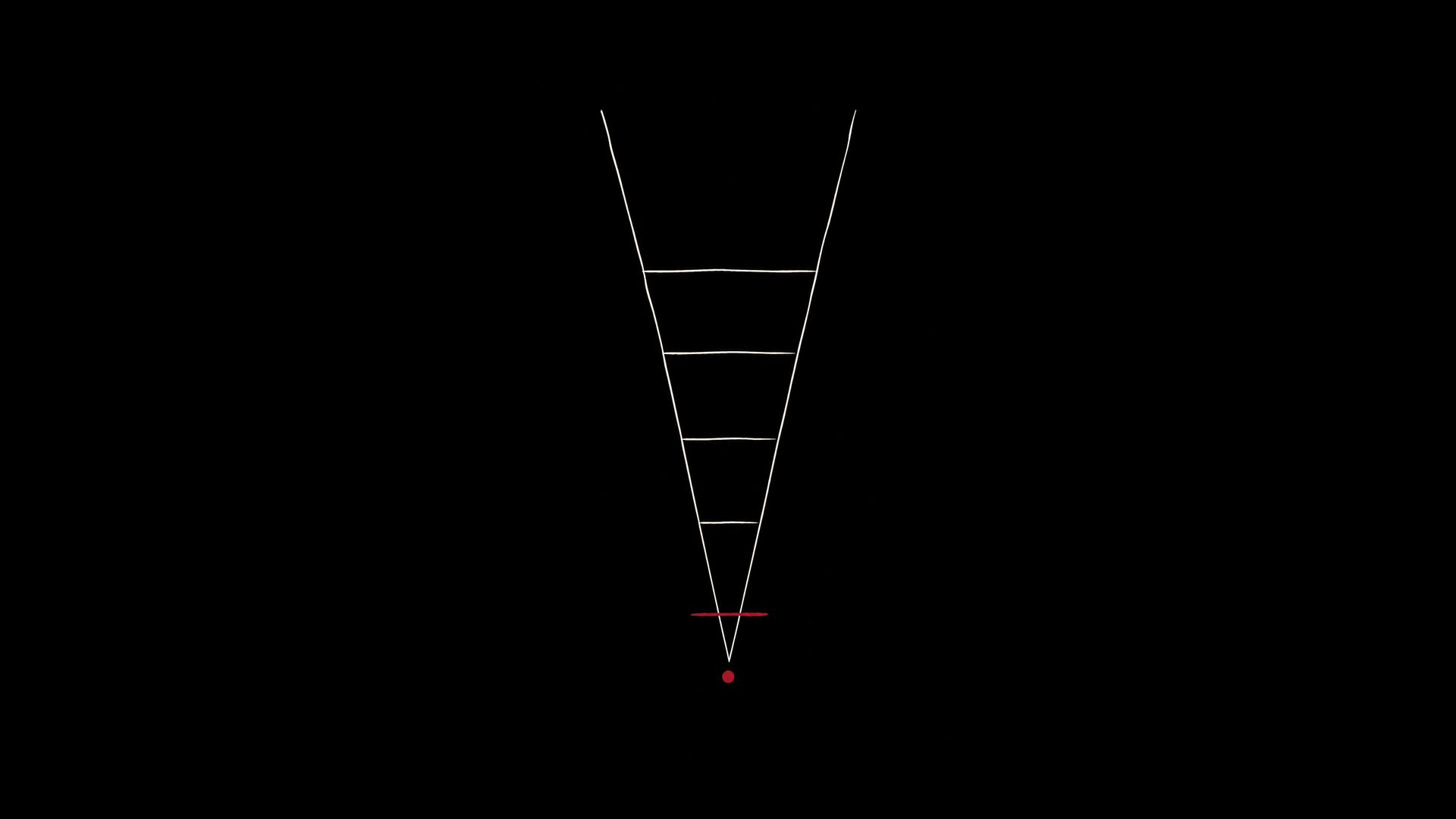
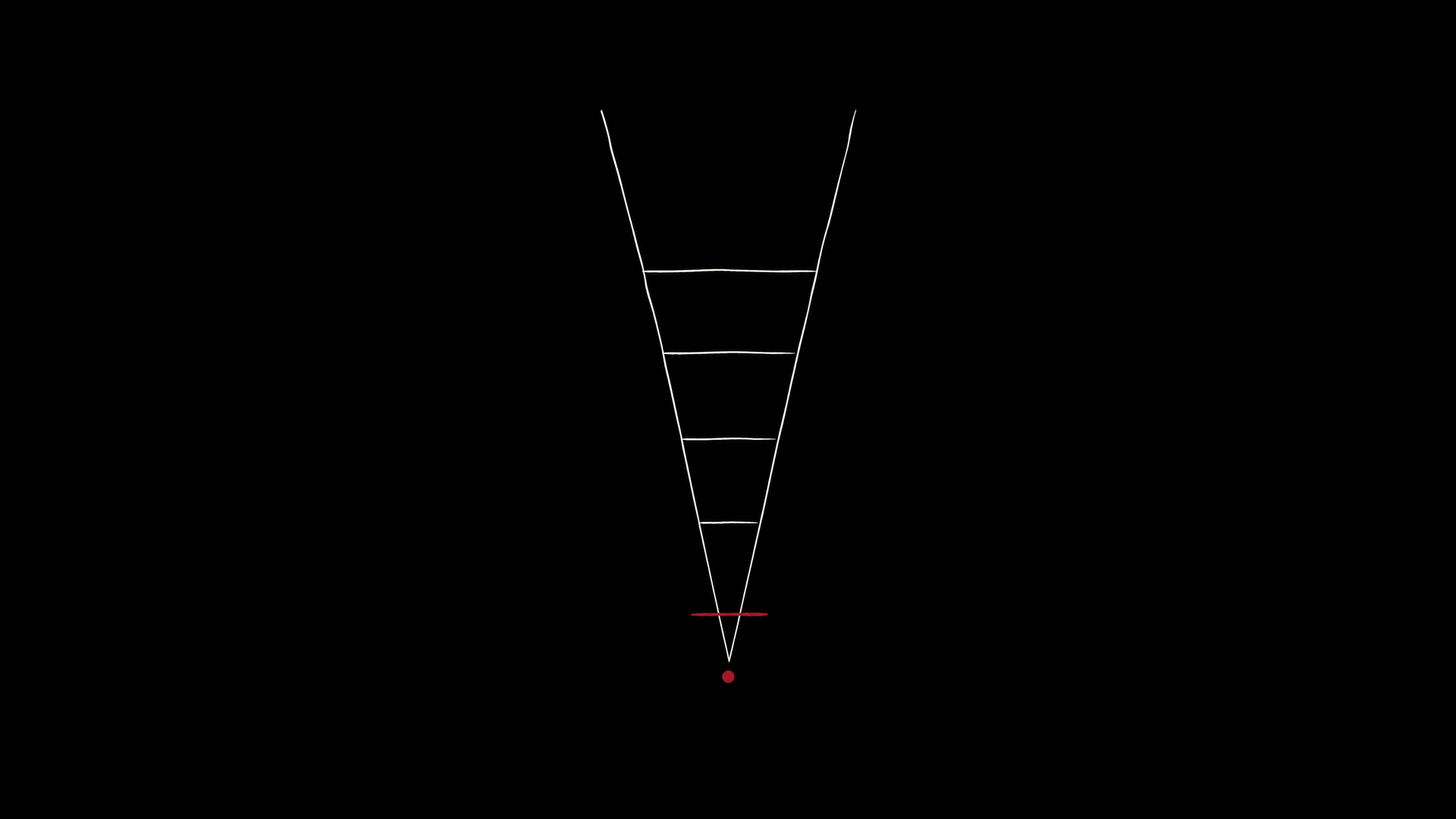
Over the years, I've found myself asking one question before we get anywhere near logos, mood boards or messaging: "What business are we really in?" Not What do we sell? Not What's our mission? Just... What business are we really in?
I ask three leaders separately. The answers tell me a lot.
If they describe the same business in different words, I usually relax. That's a positioning problem. The business understands itself; the market doesn't. That's exactly what branding is supposed to solve. But every now and then, I hear three fundamentally different answers. Different customers. Different priorities. Different definitions of success. Sometimes, they sound like they're describing entirely different businesses.
That's when I quietly put the rebrand conversation to one side. Because no amount of great design can create clarity that doesn't exist inside the leadership team.
Funny thing is, businesses almost never say, "We're no longer aligned." They say, "Our brand feels dated." Or, "We need to look more modern." It's a much easier conversation to have. Talking about colours is far less uncomfortable than talking about disagreement.
The strongest rebrands I've been part of barely started with branding at all. They started with leadership deciding who they wanted to become, who they wanted to serve and what they wanted to be known for. Once those conversations happened, the creative work became surprisingly straightforward.
I've seen the opposite too. Beautiful identities. Thoughtful messaging. Award-worthy design. And six months later, the business was still telling three different stories because the real disagreement had never been resolved.
That's why I don't think branding creates clarity. I think it amplifies it. If the organisation already knows who it is, branding helps the market understand that story. If it doesn't, branding can make the confusion look considerably more polished.
The Alignment Test
Before a significant branding conversation, ask three leaders the same question, separately: "What business are we really in?"
Then listen for the gap.
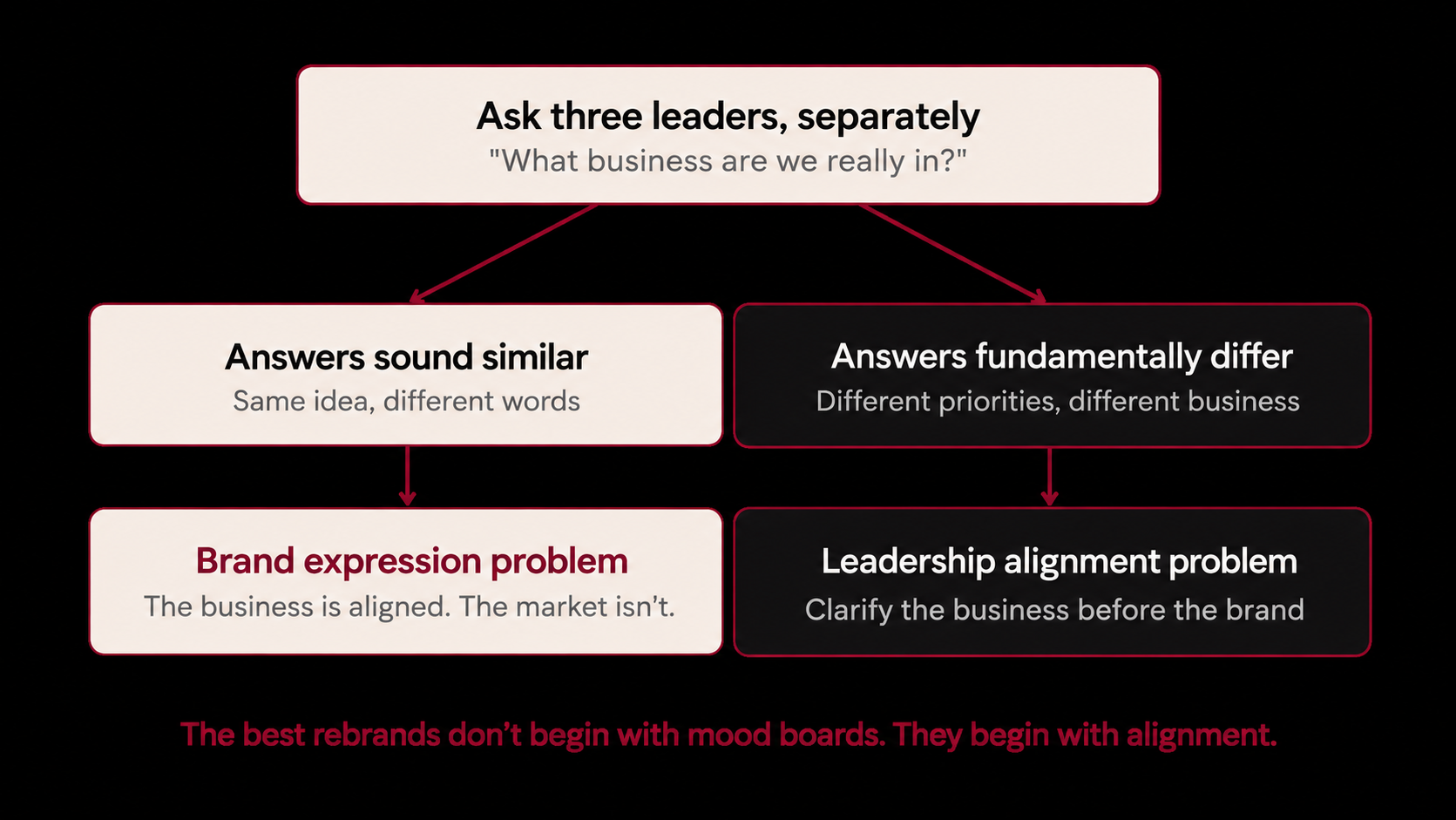
If the answers are essentially the same, you're probably looking at a brand expression problem. If they're fundamentally different, stop talking about the brand for a minute. The problem may be sitting much closer to the leadership table.
Because before you redesign the brand, you may need to redesign the conversation happening around it.
HERE’S WHAT I’D DO
Fix the alignment before you fix the brand.
NEXT IN HERE’S WHAT I’D DO
MORE I’D DO
I haven't run out of opinions yet.
COMING SOON