
How to Tell If Your "Rebrand" Problem Is Actually a Leadership Problem

I've lost count of the number of meetings that have started with someone saying, "We think it's time for a rebrand." Sometimes they're right. More often, they're describing something else.
The conversation almost always begins with the logo, the website or the visual identity. For the first few minutes, everyone behaves as though colours, typography and messaging are the problem. Then someone says something that has nothing to do with branding. They describe the customer differently from everyone else in the room. They explain the business in a way that makes another leader pause. It's usually a small moment, easy to miss if you're busy discussing design. That's normally when I stop thinking about branding.
Because what I'm looking at isn't a brand problem anymore. It's a leadership conversation that's been disguised as a creative brief.
Over the years, I've found myself asking one question before we get anywhere near logos, mood boards or messaging: "What business are we really in?" Not What do we sell? Not What's our mission? Just... What business are we really in?
I ask three leaders separately. The answers tell me a lot.
If they describe the same business in different words, I usually relax. That's a positioning problem. The business understands itself; the market doesn't. That's exactly what branding is supposed to solve. But every now and then, I hear three fundamentally different answers. Different customers. Different priorities. Different definitions of success. Sometimes, they sound like they're describing entirely different businesses.
That's when I quietly put the rebrand conversation to one side. Because no amount of great design can create clarity that doesn't exist inside the leadership team.
Funny thing is, businesses almost never say, "We're no longer aligned." They say, "Our brand feels dated." Or, "We need to look more modern." It's a much easier conversation to have. Talking about colours is far less uncomfortable than talking about disagreement.
The strongest rebrands I've been part of barely started with branding at all. They started with leadership deciding who they wanted to become, who they wanted to serve and what they wanted to be known for. Once those conversations happened, the creative work became surprisingly straightforward.
I've seen the opposite too. Beautiful identities. Thoughtful messaging. Award-worthy design. And six months later, the business was still telling three different stories because the real disagreement had never been resolved.
That's why I don't think branding creates clarity. I think it amplifies it. If the organisation already knows who it is, branding helps the market understand that story. If it doesn't, branding can make the confusion look considerably more polished.
The Alignment Test
Before a significant branding conversation, ask three leaders the same question, separately: "What business are we really in?"
Then listen for the gap.
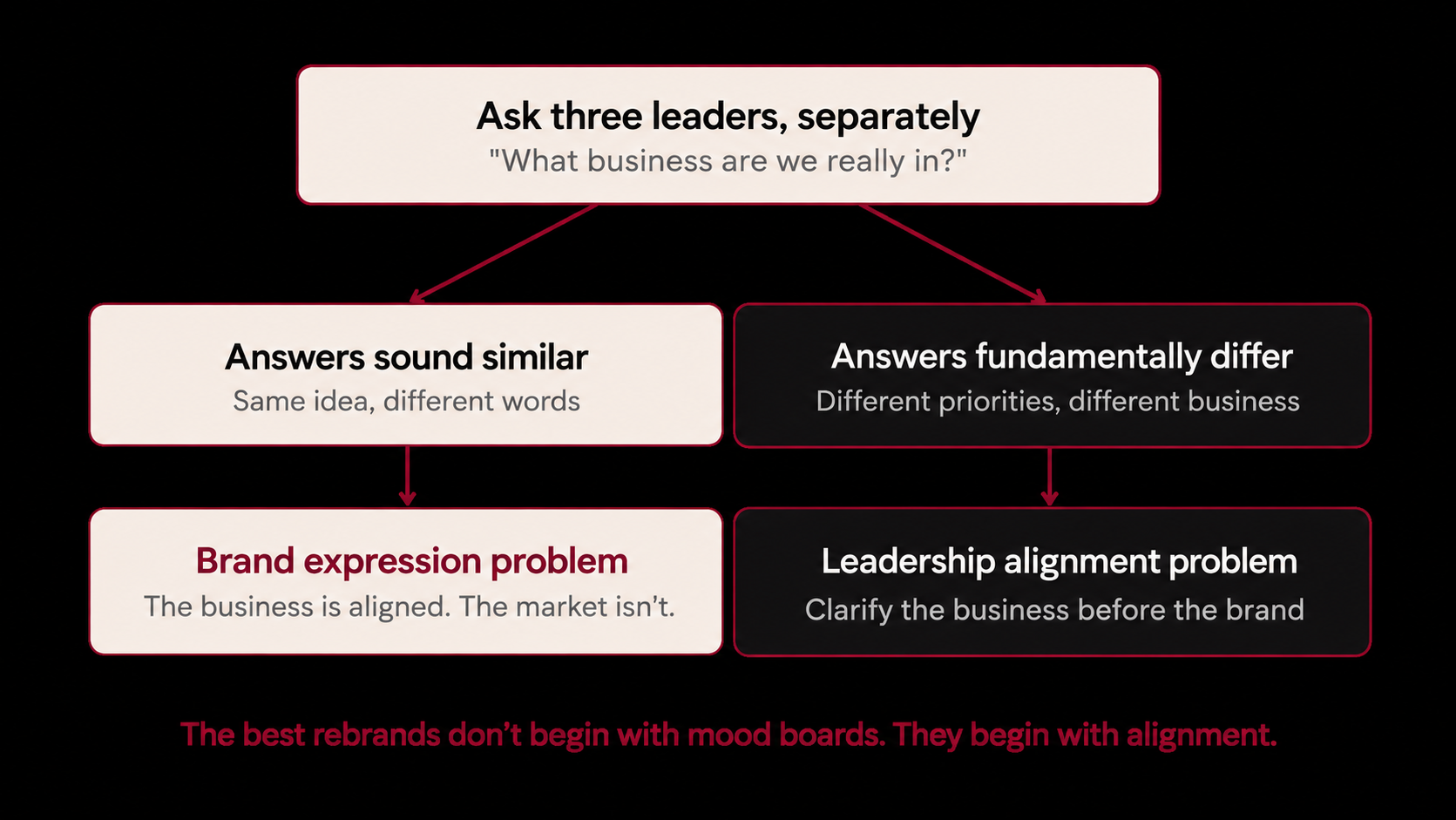
If the answers are essentially the same, you're probably looking at a brand expression problem. If they're fundamentally different, stop talking about the brand for a minute. The problem may be sitting much closer to the leadership table.
Because before you redesign the brand, you may need to redesign the conversation happening around it.
HERE’S WHAT I’D DO
Fix the alignment before you fix the brand.
NEXT IN HERE’S WHAT I’D DO
MORE I’D DO
I haven't run out of opinions yet.
COMING SOON
